
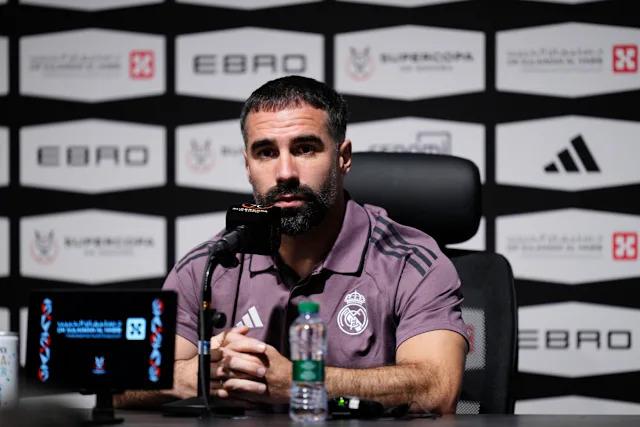
The news spread like wildfire in the last few hours at Real Madrid, generating an intense debate between fans and the media. According to various information that began to circulate, captain Dani Carvajal internally designated a player as the main person responsible for the tense climate we are currently experiencing in the white team’s locker room.
What is most striking in this case is not only the seriousness of the accusations, but also the fact that the name mentioned does not coincide with any of the usual names that are mentioned when problems arise in a club of this magnitude.
For years, Real Madrid was seen as an example of ego management in elite football. With a squad made up of international stars, the club has managed to maintain a delicate balance between individual talent and collective discipline. However, as in any human organization, especially when under constant pressure, internal conflicts are not entirely strange. The unusual thing is that these divergences transcend to the point of generating an atmosphere described as “chaotic” within the locker room.
The mention of people like Alonso and Arbeloa adds an extra dimension to the issue. Both represent not only tactical knowledge, but also the traditional values of Real Madrid fans, based on discipline, respect and commitment. The fact that a player has openly encouraged opposition to his directives suggests a significant break in the chain of authority within the sporting environment.
At the same time, it is important to emphasize that there is no conclusive public evidence to support these claims. In the world of football, especially in clubs with high media exposure, rumors can quickly amplify and take on a semblance of truth that does not always correspond to reality. However, although it is a rumor, this story reflects a latent concern: the difficulty of managing a locker room full of strong personalities in a very demanding context.
Another important aspect is that Carvajal, as captain, not only has a sporting role, but also an institutional one. Your voice in the locker room carries weight and any such accusation, even in a private context, can have important consequences for group dynamics. Captains often serve as bridges between players and the coaching staff, and their role is to accurately detect and resolve problems before they worsen.
The possible existence of a player inciting disobedience or internal conflict raises questions about the team’s culture at that particular moment. Is this an isolated case or a symptom of a deeper problem? Is the team going through a transition phase in which leadership is not yet fully defined? These are questions that inevitably arise in such a situation.
It is also worth considering the sporting context. Field performance is often closely linked to the external environment. Teams with cohesive locker rooms tend to demonstrate greater consistency and resilience in difficult times, while those affected by internal tensions may experience steeper ups and downs. If the information about the conflict has any degree of veracity, it could explain some irregularities in the team’s performance.
On the other hand, the club’s reaction will be decisive. Real Madrid is an institution with a long tradition in the discreet management of internal conflicts. In most cases, problems are resolved behind closed doors, without leaks or public statements that could damage the team’s image. In this sense, it is possible that the municipality is already aware of the situation and has taken measures to remedy it.
The role of the coach will also be decisive. Managing a locker room in these conditions requires not only tactical knowledge, but also leadership and communication skills. Identifying sources of conflict, mediating between parties, and restoring collective trust are complex tasks that can make the difference between a season’s success and failure.
Meanwhile, fans watch closely and, in many cases, with concern. Real Madrid is not just a football club, but an institution with millions of fans around the world, for whom the team represents much more than sporting results. The idea of a divided locker room contrasts with the image of unity and strength that has historically characterized the club.
However, it is also important to avoid jumping to conclusions. Throughout its history, Real Madrid has overcome difficult situations and demonstrated a remarkable capacity for resilience. Even in times of crisis, the team managed to reorganize and return to competing at the highest level. In this sense, internal conflict, no matter how serious, does not necessarily determine the fate of the season.
Ultimately, the veracity of the allegations and the identity of the named player remain unclear. What is obvious is that these types of stories highlight the complexity of modern football, where individual talents must be integrated into a collective project under constant pressure. Managing this balance is one of the biggest challenges for any club and Real Madrid is no exception.
As the days go by, it will be interesting to see if new information emerges to clarify the situation or if, on the contrary, the issue is diluted like so many other rumors that are not confirmed. The truth is that beyond names and speculation, the team must invest in recovering stability and maintaining the competitive level expected of an institution of its caliber.
In football, as in life, conflicts are inevitable. What truly defines a team is not the absence of problems, but the way to face and overcome them. Real Madrid, with its history and experience, has the resources to achieve this. The question is whether this episode will be another obstacle or the beginning of a greater challenge that will test the strength of the group.
L