
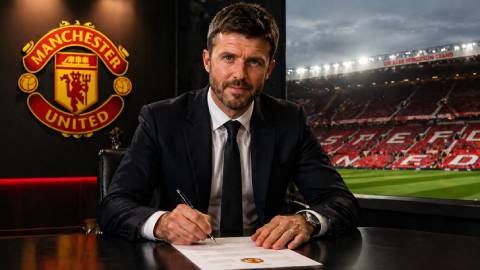
Manchester United have entered a new structural phase following the confirmation of Michael Carrick as permanent head coach, a decision that reflects both continuity and calculated ambition. The appointment follows a period of interim leadership that gradually stabilised performances and repositioned the club within Champions League contention.
The development has become a key talking point across English football, not simply because of the managerial change, but due to its broader implications for identity and long-term planning at Manchester United. Questions were raised over whether continuity would outweigh the demand for proven elite-level experience.
From the outset, Carrick’s tenure had been subject to mixed reaction, particularly given historical caution following internal appointments. However, his ability to guide the team into a more stable competitive position appears to have strengthened internal confidence, ultimately influencing the decision to formalise his role on a long-term contract.
Discussion among pundits and former players has reflected this divide. Some voices within the game argued that Carrick’s familiarity with the club offers a strategic advantage, while others suggested that emotional alignment alone may not suffice in a league defined by tactical innovation and relentless performance standards.
Comparisons have inevitably been drawn with previous internal appointments, particularly in the context of post-Alex Ferguson managerial transitions. That historical backdrop adds further scrutiny, as Manchester United seek to avoid repeating cycles of short-term optimism followed by structural inconsistency.
Supporters of the decision have emphasised Carrick’s developmental pathway, including his managerial experience at Middlesbrough. That period is viewed as tactically formative, allowing him to refine his approach outside the immediate pressures of Old Trafford before returning to a more demanding environment.
At the core of the debate lies a fundamental question regarding identity. Carrick’s appointment signals a deliberate shift towards internal understanding and cultural continuity, rather than external disruption. The club appears to prioritise alignment with its historical values alongside competitive rebuilding.
Within the dressing room, reports suggest that players have responded positively to Carrick’s leadership style. This internal buy-in is considered a critical factor, particularly during transitional phases where tactical clarity must be supported by collective commitment and belief.
From a structural standpoint, the five-year contract indicates a departure from reactive decision-making. Manchester United appear to be committing to a project-based model, where managerial philosophy is given time to mature rather than being judged solely on immediate results.
Tactically, Carrick is perceived as a coach who values control within matches. His approach emphasises structured build-up, positional awareness, and measured transitions, reflecting his own playing style as a composed midfield operator during his career.
Early observations suggest a deliberate attempt to reduce chaotic phases of play that previously defined United’s performances. Instead, Carrick appears focused on establishing predictable patterns of progression, allowing players to operate within clearly defined tactical frameworks.
However, questions remain regarding scalability. While initial performances have shown promise, the challenge will be sustaining this tactical discipline across a full Premier League campaign, particularly against opponents with established systems such as Manchester City and Liverpool FC.
The squad itself presents another layer of complexity. A blend of experienced figures and emerging talents has created an uneven profile, raising questions over cohesion. Carrick’s role will involve making precise decisions regarding squad balance and long-term suitability.
Youth development is expected to play a central role in this process. Carrick’s willingness to trust younger players aligns with Manchester United’s historical identity, but it also introduces performance variability, particularly in high-stakes fixtures.
This balance between development and competitiveness represents a recurring tension. While long-term growth requires patience, the expectations associated with Manchester United demand consistent results, particularly in domestic and European competitions.
Psychological management will therefore be as important as tactical execution. Carrick’s composed demeanor has been identified as a stabilising factor, yet there remains an expectation that he will demonstrate authority when confronted with underperformance or strategic setbacks.
The Premier League’s competitive landscape further intensifies these demands. With multiple clubs operating at high tactical efficiency, the margin for error has narrowed significantly, placing additional emphasis on consistency and adaptability.
CARRICK MEETS RATCLIFFE AND DROPS MASSIVE STATEMENT ON MAN …
Carrick’s appointment also reflects a broader philosophical recalibration within the club’s hierarchy. Rather than pursuing high-profile managerial names, the decision suggests a preference for internal coherence and long-term alignment with a clearly defined footballing identity.
Nevertheless, external perception remains divided. Some analysts view the move as a progressive step towards sustainable development, while others interpret it as a calculated risk given Carrick’s limited experience at the highest managerial level.
These contrasting perspectives contribute to ongoing scrutiny. Each performance will inevitably be assessed not only in isolation but also as evidence supporting or challenging the club’s strategic direction under Carrick’s leadership.
Transfer policy will play a decisive role in shaping outcomes. The upcoming windows are expected to test Carrick’s influence on recruitment, particularly in identifying players capable of executing his tactical principles within a high-intensity league environment.
Equally, decisions regarding departures will carry significant weight. Removing players who do not align with the system is often as important as recruitment, particularly in achieving tactical cohesion and dressing room clarity.
The return to Champions League competition introduces another dimension. Competing at that level requires squad depth, tactical flexibility, and mental resilience, all of which will test Carrick’s capacity to manage multiple competitive priorities simultaneously.
European fixtures also provide a platform for assessing tactical adaptability. Carrick’s ability to adjust his approach against diverse opposition styles will be closely monitored as an indicator of his progression as a coach.
Internally, the club hierarchy appears aligned behind the project. This unified backing may prove critical during periods of inconsistency, allowing Carrick the operational stability required to implement long-term structural changes.
However, as history has shown, patience at Manchester United is often conditional. Early setbacks could quickly shift the narrative, reinforcing the importance of maintaining competitive momentum during the initial phases of this new era.
Media discourse is expected to remain intense, with each tactical decision and selection choice analysed in detail. Carrick’s communication style, both publicly and within the club, will therefore influence how narratives evolve over time.
Ultimately, the appointment represents both opportunity and calculated exposure. It offers a pathway to redefine the club’s identity while simultaneously placing significant responsibility on a relatively inexperienced manager.
The broader question concerns sustainability. Can Carrick translate initial stability into consistent high-level performance, and can that performance evolve into tangible success within domestic and European competitions?
At present, definitive conclusions remain premature. The early indicators suggest structural improvement, yet the long-term viability of the project will depend on execution across multiple interconnected areas, including tactics, recruitment, and player development.
As the season progresses, the focus will shift from theoretical promise to measurable outcomes. Each match will contribute to a growing body of evidence regarding Carrick’s suitability for one of football’s most demanding managerial roles.
For now, the situation remains under observation. Manchester United’s strategic reset under Michael Carrick has begun, but its ultimate trajectory continues to develop within a highly competitive and constantly evolving football landscape.